
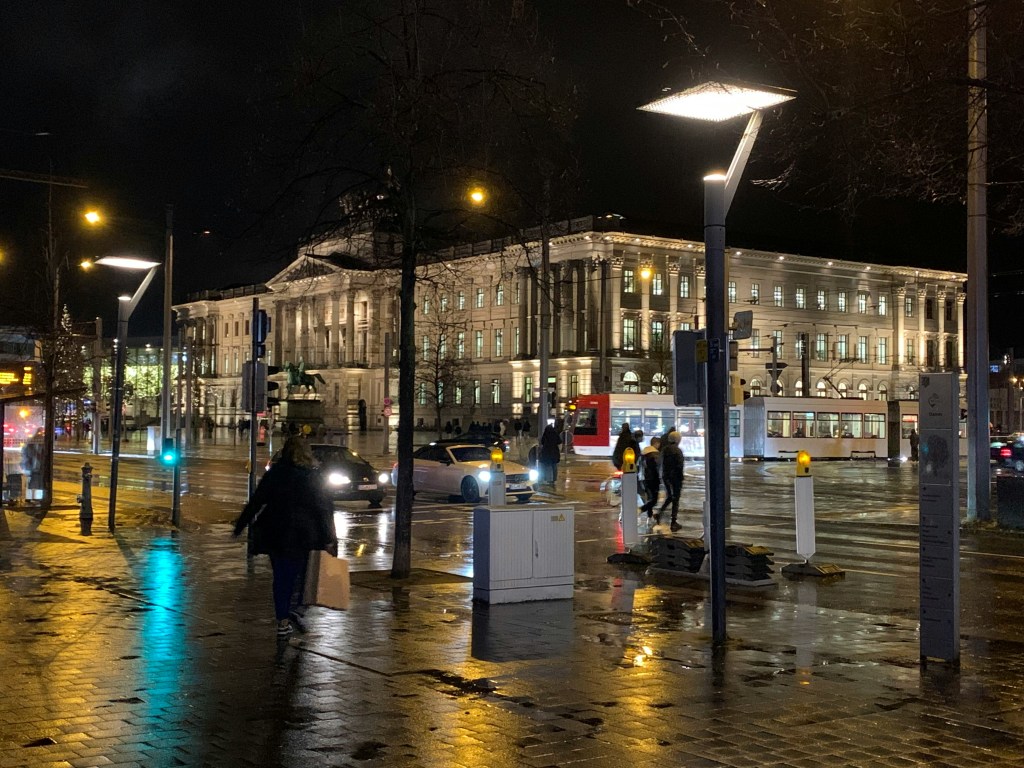
The high of the previous night had evaporated, replaced by the sterile hum of a fluorescent light and the bitter taste of stale coffee. Jake and Emma sat across from each other in a windowless debriefing room, the echoes of London’s rain replaced by the rhythmic clicking of a senior analyst’s keyboard. The adrenaline was gone, leaving behind a profound, bone-deep exhaustion.
Director Hayes entered, a woman whose every movement was an exercise in controlled efficiency. She didn’t offer praise or congratulations. Instead, she slid a folder across the table, its contents marked with the highest classification.
“The arrests were clean,” Hayes began, her voice a low, precise instrument. “We recovered the bomb’s schematics and a hard drive. But the men you brought in, they’re nothing. Foot soldiers. Ideologues. They were expendable.”
Jake’s jaw tightened. “And the briefcase? The bomb was active.”
“It was a statement,” Emma interjected, her eyes never leaving Hayes. “A public show of force. The real target isn’t the public. It’s us. They wanted to prove they could hit us anywhere, anytime.”
Hayes nodded approvingly. “Precisely. The hard drive is encrypted with a level of code we’ve never seen before. We have our top cryptologists working on it, but it could take days or even weeks. Sandalwood isn’t just a terror cell; it’s a ghost in the machine. Their real leader is known to our analysts by only one name: The Architect.”
A silence settled over the room, heavy with the weight of the unknown. They had stopped the immediate threat, but the core of the problem remained untouched. The Architect was a phantom, a myth whispered in the dark corners of the intelligence world.
“We have one lead,” Hayes continued, pushing another document across the table. It was a single line of text, taken from a recovered fragment of encrypted communication. “The Nightingale’s Song.”
Jake leaned forward. “What is it? A person? A project?”
“We don’t know,” Hayes admitted. “It was a recurring phrase, almost a codename, in the communications we managed to intercept. It’s the only thing that stands out. It’s a risk, but it’s all we’ve got.”
She looked from Jake to Emma, her gaze sharp and unwavering. “This isn’t a surveillance mission anymore. This is a ghost hunt. I’m taking you both off the grid. You’re our spearhead. Find ‘The Nightingale’s Song’ and you’ll find The Architect. But understand this: you’re on your own. No backup, no official support. If you get caught, we never knew you.”
Emma’s lips pressed into a thin line. Jake ran a hand through his hair, the frustration etched on his face. The victory of the previous night felt hollow, a temporary reprieve before a much larger storm.
“Another day at the office,” Jake muttered, the words a bitter echo of his own from a few hours before.
“No, Jake,” Emma corrected, her voice resolute. “This is the real mission.”
They stood up and walked out of the room, leaving the sterile quiet behind. The city outside was alive, a million stories happening at once. They had to find the one that mattered, the one that could save them all. They had to find The Nightingale.
The old Vauxhall had seen better days, but its anonymous appearance was exactly what Jake and Emma needed. Parked on a quiet street in Soho, it was their new mobile command centre. Emma had a handful of laptops scattered across the dashboard, their screens a constellation of data and code. Jake was on the phone, a burner, his voice a low rumble as he tried to pull information from a contact who owed him a favour.
“The Nightingale’s Song,” Jake repeated into the phone. “Anything? A location, a person, anything that feels… off.”
The voice on the other end was clipped and hesitant. “That’s a deep cut, mate. Sounds like a dead drop or a phrase from way back. Nothing modern.” He hung up, frustration building. “Nothing. My source says it’s not in the contemporary lexicon. It’s either old or completely new.”
Emma, meanwhile, had been chasing a different thread. She wasn’t just searching for the phrase itself, but for the linguistic and historical context behind it. She cross-referenced the term with old MI6 debriefs and obscure historical documents she’d found in an unindexed digital archive. The files were from the Cold War, from a time when spycraft was less about data and more about human networks and coded language.
“I think I have something,” she said, her voice a low hum of concentration. “In the 1970s, MI6 ran an operation to infiltrate a Soviet sleeper cell. Their most valuable asset, a mole inside the KGB, was codenamed ‘The Nightingale.’ His encrypted communications would always end with the phrase, ‘The song will be sung at dawn.’ But here’s the thing… they were never able to confirm his real name or location.”
Jake’s eyes narrowed. “A codename for a mole. ‘The Nightingale’s Song’ could be a reference to the mole’s identity, a piece of information that was lost to history.”
“Exactly,” Emma said, her fingers flying across the keyboard. “But there’s more. The mole’s handler was a cryptographer who had a secret safe house. It was a place where he stored all of his most sensitive files. The location was never formally recorded, but in a series of his personal letters, he refers to it as ‘the place where the forgotten books are kept.’ He was a professor of ancient languages at a university in London.”
The pieces began to click into place. “A university library,” Jake said, his mind racing. “But which one?”
Emma brought up a map of London, overlaying it with historical data. The professor had worked at several institutions, but one stood out. A small, unassuming building near Russell Square, an adjunct to a much larger, more public library. It was an old building, filled with dusty, uncatalogued archives. It was a perfect blind spot. A place where a forgotten secret could be kept for decades.
“The Nightingale’s Song isn’t a song at all,” Emma concluded. “It’s the name of the file, the key to the mole’s identity. The Architect isn’t building a cell; he’s finding the foundation of a previous one. He’s looking for the next ghost.”
Jake nodded. He knew the building, had walked past it a dozen times. To the untrained eye, it was just another part of London’s vast historical landscape. But now, it was a target. The real mission was about to begin. They had a location, a target, and a ghost. Now they just had to get inside.
The building was a tomb of forgotten knowledge, a small stone annexe attached to the main university library. Its windows were dark, and the rain-streaked facade was stained with the grime of a century. Jake and Emma stood across the street, their gazes fixed on the building’s few security features: a single CCTV camera, an ancient but functional CCTV camera and an electronic lock on the heavy oak door.
“The sensor is a relic from the early ’90s,” Emma whispered, her fingers already working on a sleek tablet. “The encryption is weak, and the signal is easy to spoof.”
Jake nodded, his eyes scanning the surrounding area. London was a city of a thousand eyes, but at this time of night, this quiet corner was a blind spot. “The camera’s a different story. It’s on a hardwired circuit. I can take it out, but it’ll alert them.”
“Give me two minutes,” Emma replied. She didn’t look at him, her focus absolute. She wasn’t just bypassing the lock; she was creating a ghost in the system, a digital echo that would fool the main security hub into thinking the lock was still engaged. A soft green light blinked on her tablet, a silent victory.
“Door’s open,” she said. Jake moved first, a shadow in the lamplight. He inserted a small, specially-made tool into the lock, a physical override for the electronic mechanism, and the door clicked open. They slipped inside, leaving the door to swing shut behind them with a low thud.

 In the heart of London - Surveillance at a glance...
Leave a comment