The grey rain of Kilburn didn’t wash away the history; it only made the shadows darker. For Sean O’Keeffe, those shadows were getting longer every hour.
Ten years ago, he’d been a Commander, a name whispered with reverence in certain backrooms in Derry and Belfast. Now, he was just an old man with a slight limp, a bad cough, and a terrifying amount of knowledge about things better left forgotten. He’d broken the golden rule: he’d tried to cash out, to leave the ‘Armed Struggle’ behind and fade into the massive, anonymous machinery of London.
He had been careful. No electronics, cash only, different beds every month. He was a ghost. But someone, somewhere, had talked.
He knew he was ‘burned’ thirty minutes ago. It wasn’t a sudden ambush; it was the atmosphere. The street felt empty in the wrong way. A delivery van had circled the block twice, its tyres too smooth for a hard-working trade vehicle. A woman walking a dog on the other side of the high street had been looking at the reflection in a shop window, not at him.
O’Keeffe had spent his life reading the street. He didn’t panic. He just turned left, then right, slipping into the maze of terraced housing behind the main drag, his breath catching in his lungs, heading instinctively east, away from the familiar. He needed space, and he needed a different kind of hiding place.
In the unmarked trade van, parked by a defunct bus stop on the A10, the atmosphere was tight with focused intensity.
“He’s moving,” Emma said, her fingers dancing over the keyboard. She was the analyst, the digital ghost who inhabited the surveillance network. “The tracking beacon we tagged onto his dry-cleaning plastic two days ago is transmitting. He’s ditched the coat, but the signal’s still active in Kilburn. Smart.”
“He wouldn’t be alive if he wasn’t,” Jake replied, his hands loose but ready on the steering wheel. Jake was the operative, the physical shadow. His eyes constantly scanned the side mirrors, watching the flow of traffic without appearing to focus on any single car. “Where’s the physical contact?”
“He’s been ‘boxed’ by Mobile Teams One and Two,” Emma said. “They picked him up walking toward Finsbury Park. He’s trying to shake the tail, using the backstreets, but he’s heading towards a specific node.”
She clicked a button, bringing up a live analysis on the main monitor. A map of London showed a red icon—O’Keeffe—moving towards the orange dots of the tube stations.
“He’s heading for Seven Sisters. He’s going to ground, and he’s going to try and vanish into the crowds.”
“Too exposed,” Jake countered. “Not for him. He wants mobility, not stagnation. Seven Sisters gives him the Victoria line, the overground, and dozens of bus routes. It’s a logistical nightmare for us.”
Emma’s screen beeped. “Alert from Transport for London (TfL) link. ANPR camera hit. A ’98 Volvo, registered to a shell company we know he’s used, just crossed the camera on the A503. He didn’t take the tube. He must have pre-arranged a clean car.”
Jake smirked slightly. “Pre-digital thinking. He trusts engines, not microchips. He’s heading east.” He started the van, merging smoothly into the flow of traffic. “Which way, Em?”
“The A12 corridor,” she replied instantly, adjusting the filters on the digital map. “He’s skipping the M1 and M11. He’s avoiding major speed traps and static police points. He wants a long, slow vanish.”
Jake steered the van through the heavy traffic of North London, keeping two cars and a motorbike between them and the target’s estimated path, based on Emma’s predictive algorithm. They weren’t ‘following’ him in the traditional sense; they were navigating the possibility space of his escape.
“Where is he heading?” Emma mused, looking at the unfolding route. “Romford? Colchester? Not many places to hide for a legend.”
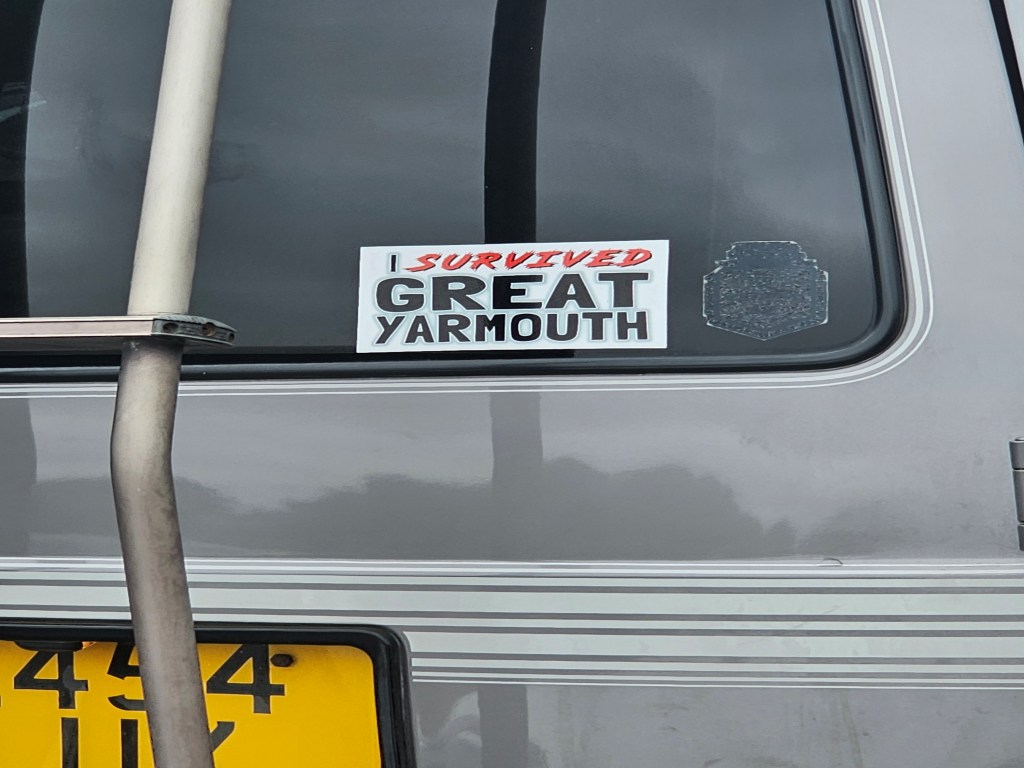
Jake glanced at the map, seeing the final destination of the road. A realisation clicked. “He’s going to the edge of the world. Great Yarmouth.”
Emma looked up, eyebrows raised. “Yarmouth? That faded resort in Norfolk? Why?”
“Think about it,” Jake said. “It’s an island, essentially, between the sea and the Broads. Off-season, it’s a town of whispers, cheap B&Bs, and a floating population that nobody asks questions about. It’s got a small port, easy to get a fishing boat across to the continent or back to Ireland. It’s the perfect place for an old operative to wait for a pickup.”
The drive along the A12 was a long exercise in discipline. O’Keeffe drove precisely at the speed limit, his eyes constantly moving to his mirrors, but never making a move sudden enough to provoke a reaction. The flat, damp landscape of Essex and Suffolk blurred past him. He felt the phantom pressure of eyes on him, but every car that seemed suspicious eventually turned off or sped past.
Yet the pressure never left. He wasn’t paranoid; he was experienced. He knew how the modern game was played. The technology was different, but the intent was the same. He wasn’t being chased; he was being shepherded.
As he crossed the border into Norfolk and the flat, sprawling marshes of the Broads opened up, the air felt colder, smelling of salt and decay. The lights of Great Yarmouth—the faded neon arcades, the lonely pier jutting into the North Sea—appeared on the horizon like a beacon of false hope.
He drove into the town, bypassing the main seafront, and headed for the maze of narrow streets behind the Hippodrome. He parked the Volvo two streets away from his intended destination, a dilapidated guesthouse with a sign that promised ‘Vacancy: Long Term Rates’ in hand-painted letters.
Five miles back, Jake and Emma watched the digital signature on the monitor merge with the urban heat map of Yarmouth.
“He’s stopped,” Emma said. “The Volvo has been registered static on Deneside.”
Jake pulled the van off the A12, navigating the final approach with meticulous care. They didn’t drive into the town; they circled it, using the industrial roads by the river Yare to find an elevated position in a disused railway siding overlooking the town centre.
“Position established,” Jake whispered, killing the engine and activating the thermal and night-vision capabilities of the van’s external camera cluster.
Emma manipulated the camera, zooming in on the Volvo, then sweeping the area. “Found him. Thermal blooming. He just left the vehicle. He’s on foot.”
She watched the white heat signature navigate the cold, blue streets. “He’s entering a property on St. Peter’s Road. Looks like a cheap hotel. ‘The Seabreeze.”
On the thermal screen, they watched the heat signature rise floor by floor, finally stopping and settling in a front room overlooking the street.
“Target has established a temporary safe house,” Emma said, her voice quiet but firm. “He seems relaxed. The thermal readout shows his heart rate is within normal resting parameters. He believes he’s safe.”
Jake leaned back, the tension in his shoulders easing only slightly. The real work began now. They had tracked him across the country, not through high-speed chases, but by anticipating his moves and understanding the digital and physical architecture he tried to evade.
“Contact the local police and the counter-terrorism branch,” Jake said, his eyes still fixed on the thermal image of the lonely figure in the seaside guesthouse. “Relay the location. Tell them we have custody of the target. We maintain observation until the extraction team arrives.”
He picked up the binoculars, looking out over the faded glory of Great Yarmouth. The man down there, a former commander of a deadly army, was now just a heat signature, a digital marker on Emma’s screen, caught in a net made of technology and patience. They had herded him to the end of the line, and there was nowhere left for him to run.
The condensation on the van’s windscreen mirrored the fog rolling off the Yare River. Inside, the hum of Emma’s servers was the only heartbeat.
“He’s moved to the window,” Emma whispered, her eyes fixed on the thermal feed. The white silhouette of O’Keeffe was a pale ghost against the blue-black brickwork of ‘The Seabreeze’ guesthouse. “He’s checking the street. Three-minute intervals. He’s not sleeping, Jake.”
Jake didn’t look up from his own monitor, which was cycling through local CCTV feeds he’d hijacked from a nearby amusement arcade. “He’s waiting for a signal. You don’t come to Yarmouth for the bracing North Sea air in November unless you’re meeting a boat or a ghost.”
“Wait,” Emma leaned in. “I’ve got a secondary heat signature. Alleyway behind St. Peter’s Road.”
A small, vibrant splash of white appeared on the screen, moving with a jagged, hurried gait. It wasn’t the measured stride of a professional.
“Zooming,” Emma muttered. The digital grain cleared. “It’s a kid. Maybe nineteen. Grey hoodie, tracksuit bottoms. He’s carrying a heavy rucksack.”
Jake shifted into the driver’s seat, his hand hovering near the ignition. “The courier. O’Keeffe isn’t just hiding; he’s distributing. If those are archives or encrypted drives, we can’t let them vanish into the Broads.”
Inside the cramped room of the guesthouse, O’Keeffe didn’t turn on the lights. He didn’t need to. He knew every inch of the room by touch—the sagging mattress, the smell of damp wallpaper, the way the floorboard groaned three inches from the door.
A soft, rhythmic tapping came from the fire escape. Three shorts, one long. The old cadence of the ‘Glenside’ cell.
O’Keeffe opened the window. The cold salt air bit at his face. The boy in the hoodie scrambled in, shivering.
“You’re late, Liam,” O’Keeffe said, his voice a gravelly rasp.
“The A47 was crawling with feds, Uncle,” the boy panted, dropping the bag. It hit the floor with a metallic clink. “They’re everywhere. I thought I was jumped at the Acle Straight.”
O’Keeffe looked at the bag. It didn’t contain electronics. It contained heavy, oiled-paper parcels. “The digital age is a lie, Liam. If it’s on a drive, they own it. If it’s on paper, you have to bleed to take it.” He reached into the bag, pulling out a ledger—a handwritten record of names, dates, and bank accounts that stretched back thirty years. The ‘Pension Fund.’
“We move at 04:00,” O’Keeffe said. “The Mary-Ann is docked at the South Quay. The skipper’s been paid in Krugerrands. We go to Zeebrugge, then we disappear.”
“They’re prepping to move,” Jake said, his voice dropping an octave. He’d seen the shadow of the rucksack pass the window. “Emma, kill the streetlights on St. Peter’s. Give them the dark they want. It’ll make them overconfident.”
“Done,” Emma tapped a sequence. A block away, the orange glow of the sodium lamps blinked out, plunging the guesthouse into a pocket of artificial midnight. “I’m also looping the arcade’s CCTV so the local police don’t see our ‘intervention.’”
Jake stepped out of the van, the click of his tactical holster the only sound in the damp air. He didn’t wear a mask; he wore the anonymity of a shadow.
“I’m moving to the primary exit,” Jake said into his comms. “Stay on the thermal. If a second vehicle enters the ‘kill zone,’ you blow the electronic countermeasures. I want their phones dead, and their car engines stalled.”
“Copy that,” Emma replied, her heart hammering against her ribs. “Target is moving toward the door. The kid is leading. Jake—O’Keeffe is armed. I see a high-density mass tucked into his waistband. Likely a Browning.”
Jake didn’t respond. He was already a ghost in the fog, moving through the back alleys of Yarmouth with a predatory grace.
As the front door of ‘The Seabreeze’ creaked open, O’Keeffe stepped out into the blackness. He paused, sniffing the air like an old wolf. The silence of the street was too perfect. The lack of light was too convenient.
He reached for his belt, but the darkness in front of him suddenly solidified.
“Evening, Commander,” a voice said, calm and cold as the North Sea. “The Mary-Ann isn’t sailing tonight. But I hear the weather in Belmarsh is lovely this time of year.”
O’Keeffe froze. He couldn’t see the man, but he felt the laser dot—a tiny, stinging point of red light—settle right over his heart.
“Who are you?” O’Keeffe whispered.
“Just a shadow you forgot to check,” Jake replied.
The red dot remained motionless on O’Keeffe’s chest, a steady, unblinking eye in the Norfolk fog.
Behind the old man, the boy, Liam, panicked. He reached for the heavy rucksack, his fingers fumbling with the zip, perhaps looking for a weapon or just trying to shield the contents.
“Don’t,” Jake’s voice cut through the damp air, sharp as a razor. “The bag stays on the pavement. Hands where I can see them, son. Don’t throw your life away for a war that ended before you were born.”
O’Keeffe sighed, a long, rattling sound. He slowly raised his hands, palms open. The weight of the Browning Hi-Power in his waistband felt like a lead anchor. He knew the geometry of this street; there was no cover, no exit. He was caught in a ‘hard-point’ ambush.
“You’ve been chasing a ghost, lad,” O’Keeffe said, his voice surprisingly steady. “There’s nothing left but paper and regrets.”
“The paper is exactly what we want,” Jake replied, stepping forward into the faint light of a distant, flickering shop sign. He kept his own weapon low but ready. “Emma, status?”
“Local police are five minutes out, redirected to the quay to intercept the Mary-Ann,” Emma’s voice crackled in Jake’s ear. “I’ve jammed all cellular signals within a two-block radius. They’re isolated.”
The Final Confrontation
Jake moved with practised efficiency. He didn’t rush. He forced O’Keeffe and the boy against the peeling brickwork of the guesthouse. With a swift motion, he disarmed the old man, sliding the heavy pistol into his own pocket.
“The ledger, Sean,” Jake said, gesturing to the rucksack. “The one they call the ‘Pension Fund.’ Who’s on the list?”
O’Keeffe looked at the bag, then at Jake. A tired smirk touched his lips. “It’s not just names of soldiers, boy. It’s the names of the men in suits. The ones who shook hands in public and signed the checks in private. It’s thirty years of ‘insurance’.”
Jake knelt, keeping his eyes on the suspects, and flipped the bag open.
The Contents of the ‘Pension Fund’
Inside were three thick, leather-bound ledgers, their pages yellowed and smelling of old tobacco and damp cellars. Emma’s head-mounted camera, synced to Jake’s tactical vest, began scanning the pages as he flipped through them.
In the van, Emma’s monitors exploded with data as the OCR (Optical Character Recognition) software went to work.
• The ‘Commercial’ Tier: Lists of front companies—construction firms in North London, pubs in Manchester, and haulage businesses in Kent—that had been laundering “revolutionary taxes” for decades.
• The ‘Political’ Tier: This was the explosive part. Encrypted notations next to names that Emma recognised from current news cycles. Donations made through offshore accounts in the Isle of Man and the Cayman Islands, tying legitimate political figures to historic “black bag” operations.
• The ‘Logistics’ Tier: GPS coordinates for “deep-cache” arms bunkers across the UK and Ireland—locations that had been forgotten by the modern leadership but were meticulously recorded here.
“My God,” Emma whispered into the comms. “Jake, this isn’t just history. Some of these accounts are still active. Monthly transfers are going to a private security firm in Dubai as of last week.”
The End of the Road
The distant wail of sirens began to rise over the sound of the crashing waves on the beach. Blue lights flickered against the fog in the distance.
O’Keeffe looked at the ledgers. “That book is a death sentence for a lot of important people. You think you’ve won? You’ve just inherited a nightmare.”
“I’ll take my chances,” Jake said. He looked at the boy, Liam, who was shaking with cold and fear. “Get him into the van, Emma’s bringing it around. We’re not handing these books over to the locals. This goes straight to the ‘Glass House’ in London.”
As the van pulled up, its headlights cutting through the mist like twin blades, Jake hauled the rucksack over his shoulder. The ‘Commander’ was silent now, his eyes fixed on the dark horizon of the North Sea. The era of the shadow war was finally being dragged into the light of a digital morning.
The decrypt on the Dubai account didn’t just open a door; it blew the hinges off a vault that had been sealed since the 1990s.
As the van sped back toward London, Emma sat bathed in the blue light of her monitors, her fingers flying across the keys. The “Pension Fund” was a digital hydra. Every time she mapped one shell company, three more appeared in the ledger’s margins, coded in a shorthand that O’Keeffe had likely thought would never see the light of day.
The Dubai Connection: “Project Osprey”
“Jake, look at this,” Emma said, her voice tight. “The Dubai transfers aren’t going to a person. They’re funding a private maritime security firm called Osprey Solutions. On paper, they protect tankers from pirates in the Gulf of Aden.”
“And off the paper?” Jake asked, his eyes mirrored in the rearview as he navigated the A12.
“They’ve been buying decommissioned British military hardware. Small arms, night-vision gear, encrypted radios. And according to the shipping manifests in O’Keeffe’s ledger, the ‘protection’ they’re providing is actually a logistics pipeline. They aren’t just moving money; they’re moving a modern arsenal back into Western Europe.”
The Political Fallout in Westminster
By 03:00, the data had reached the “Glass House”—the high-security intelligence hub in Vauxhall. The reaction was seismic.
• The ‘Sleeper’ Peers: The ledgers identified two members of the House of Lords who had been receiving “consultancy fees” from the front companies for twenty years. These weren’t just bribes; they were retainers for political influence and early warnings on counter-terrorism legislation.
• The “Black Hole” Accounts: A sitting MP was found to have used an IRA-linked construction firm to renovate his country estate, hidden behind a series of subcontractors that Emma’s algorithm finally unpicked.
• The Intelligence Leak: Most damaging of all was a list of “Friendly Contacts” within the Metropolitan Police from the late 1980s. While many were retired, several had risen to senior ranks, potentially explaining why O’Keeffe had remained a “ghost” for so long.
The Midnight Raid
While the political world was still asleep, the tactical consequences were immediate. Based on the “Logistics Tier” coordinates Jake and Emma recovered, Special Branch launched simultaneous raids on three “deep-cache” bunkers:
- The Fens, Lincolnshire: A buried shipping container under a potato field yielded crates of vintage but functional Semtex and several dozen assault rifles.
- A London Lock-up: Hidden behind a false wall in a Bermondsey garage, they found the “Technical Lab”—blueprints for a new generation of non-metallic IEDs designed to bypass modern airport security.
- The Wicklow Mountains: Irish authorities, tipped off by the Glass House, moved on a remote farmhouse where the “Dubai Shipments” were allegedly being received.
The Aftermath in the Van
As the sun began to bleed over the London skyline, Jake pulled the van into a secure bay. The mission was over, but the war had just shifted into a much more complex phase.
O’Keeffe sat in the back, cuffed and silent. He looked older than he had in Yarmouth. The “insurance” he had carried for three decades had been his only protection, and now it was the very thing that would dismantle his legacy.
“You should have stayed in the shadows, Sean,” Jake said, opening the rear door.
O’Keeffe looked up, a tired glint in his eyes. “The shadows are getting crowded, son. I just wanted to be the last one out.”
Emma closed her laptop, the “Project Osprey” file now tagged with a TOP SECRET header. “You weren’t the last, Sean. You were just the one who kept the best notes.”
Another random story that didn’t go anywhere!

 In the heart of London - Surveillance at a glance...
Leave a comment